
Artificial Intelligence (AI) is no longer a concept confined to science fiction or research laboratories. It has become an integral part of our daily lives, influencing how we communicate, work, learn, shop, and even receive healthcare. As technology continues to evolve, AI is reshaping industries and creating new opportunities while also raising important ethical and social questions.
What is Artificial Intelligence?
Artificial Intelligence refers to the ability of machines and computer systems to perform tasks that typically require human intelligence. These tasks include learning from data, recognizing patterns, understanding language, solving problems, and making decisions. AI systems use technologies such as machine learning, natural language processing, computer vision, and robotics to improve their performance over time.
AI in Everyday Life
Many people use AI every day without realizing it. Voice assistants help users set reminders, answer questions, and control smart home devices. Streaming platforms recommend movies and music based on viewing habits, while online shopping websites suggest products that match customer preferences. Navigation apps use AI to analyze traffic conditions and recommend the fastest routes.
Social media platforms also rely on AI to personalize content, detect harmful material, and improve user experiences. These applications demonstrate how AI has become a silent but powerful part of modern living.
AI in Healthcare
Healthcare is one of the industries benefiting the most from AI. Doctors use AI-powered tools to detect diseases earlier, analyze medical images, and develop personalized treatment plans. AI also assists researchers in discovering new medicines by processing vast amounts of scientific data much faster than traditional methods.
Virtual health assistants and wearable devices can monitor patient health, track fitness goals, and provide early warnings about potential health issues, helping people take better care of themselves.
AI in Education
Education is becoming more personalized through AI. Intelligent learning platforms adapt lessons according to each student’s pace and understanding. Students receive instant feedback on assignments, while teachers can identify learning gaps more effectively.
AI-powered educational tools also provide language translation, accessibility features for learners with disabilities, and automated administrative tasks, allowing educators to focus more on teaching.
AI in Business
Businesses use AI to improve efficiency, reduce costs, and enhance customer experiences. Chatbots provide instant customer support, while predictive analytics helps companies forecast market trends and customer behavior. AI also automates repetitive tasks, enabling employees to focus on strategic and creative work.
In manufacturing, AI-powered robots improve production quality and workplace safety. Financial institutions use AI to detect fraudulent transactions and assess investment risks more accurately.
Benefits of Artificial Intelligence
The growing adoption of AI offers numerous advantages:
- Increased productivity through automation.
- Faster and more accurate decision-making.
- Improved customer service with 24/7 support.
- Better healthcare outcomes through early diagnosis.
- Personalized education and learning experiences.
- Enhanced safety in industries such as transportation and manufacturing.
These benefits have the potential to improve quality of life and drive economic growth across the globe.
Challenges and Ethical Concerns
Despite its many advantages, AI also presents challenges. Automation may replace certain jobs, requiring workers to develop new skills. Privacy concerns arise when AI systems collect and analyze large amounts of personal data. There are also concerns about algorithmic bias, transparency, and accountability when AI systems make important decisions.
Governments, businesses, and technology companies must work together to establish ethical guidelines that ensure AI is developed responsibly and benefits society as a whole.
The Future of AI
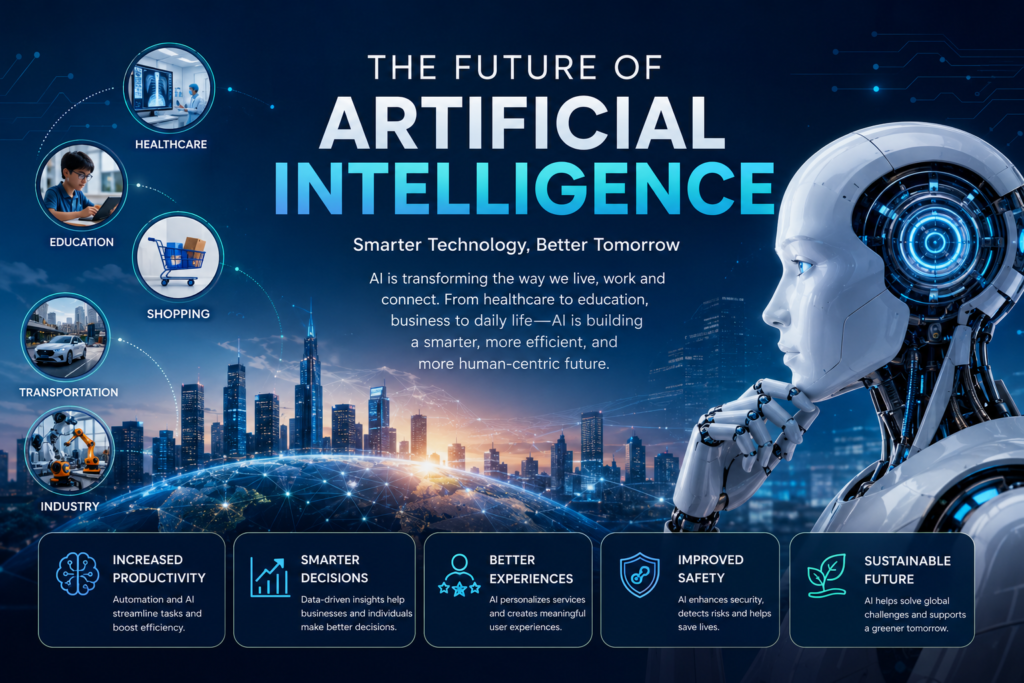
The future of Artificial Intelligence is filled with exciting possibilities. AI is expected to play a major role in autonomous vehicles, smart cities, climate change solutions, precision agriculture, advanced robotics, and scientific research. As AI systems become more capable, they will increasingly work alongside humans rather than simply replacing manual tasks.
Continuous innovation, combined with responsible regulation and ethical development, will determine how successfully society harnesses the full potential of AI.
Conclusion
Artificial Intelligence is transforming the world at an unprecedented pace. From healthcare and education to business and entertainment, AI is improving efficiency, enabling innovation, and creating new opportunities for individuals and organizations alike. While challenges such as privacy, ethics, and workforce changes must be addressed, the future of AI remains promising.
By embracing AI responsibly and investing in education, transparency, and ethical practices, we can build a future where technology empowers people, drives sustainable growth, and improves lives around the world.