
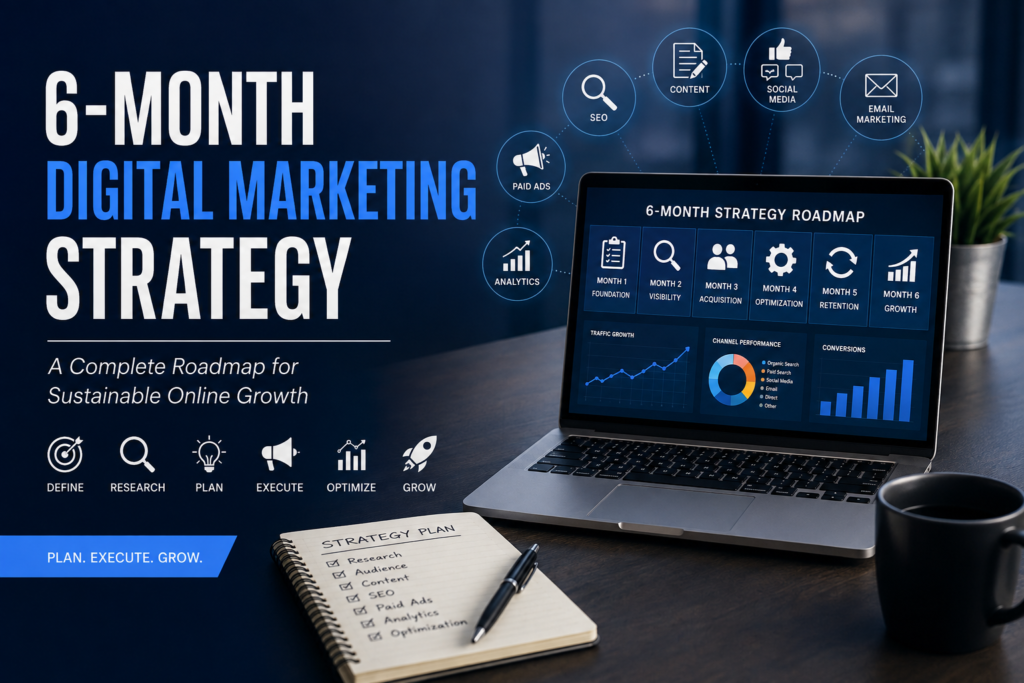
SIX month SEO framework built around a logical sequence foundation before scale, technical health before content volume, content before aggressive link building. The specific tactics inside each phase will vary by industry and business size, but the order and logic hold regardless of what you sell. Think of it as three two-month phases: Foundation, Build, and Scale.
Month 1 — Technical Foundation and Baseline
Before creating anything new, audit what already exists. Crawl the site with a tool like Screaming Frog or Sitebulb to surface broken links, duplicate content, missing meta tags, orphaned pages, and indexing problems. Check Core Web Vitals and page speed through Search Console and PageSpeed Insights, and confirm mobile-friendliness, sitemap accuracy, robots.txt rules, and canonical tags are all correct. Set up or clean up Google Search Console and GA4 properly, and choose a rank-tracking tool. Record baseline numbers for organic traffic, keyword rankings, domain authority, and organic conversion rate — you’ll need these to prove progress later. Round out the month with a competitive scan: who currently ranks for your target terms, what content format wins those rankings, and what their backlink profiles look like. Fix critical technical issues before moving forward; content and links built on a broken technical base underperform no matter how good they are.
Month 2 — Keyword Architecture and On-Page Optimization
With the technical base solid, build out the keyword strategy. Go beyond a flat list — map keywords to search intent (informational, navigational, commercial, transactional) and to stages of the buyer journey, then group related terms into topic clusters, each with one pillar page and several supporting pages linking into it. Prioritize by a mix of search volume, ranking difficulty, and business relevance; a lower-volume term that maps directly to what you sell usually beats a high-volume term with vague intent. While that map takes shape, optimize existing pages: rewrite title tags and meta descriptions to match intent and improve click-through, fix header hierarchy, tighten internal linking between related pages, and add schema markup where it applies. By the end of the month you should have a prioritized content calendar and a site where every existing page is pulling its weight.
Month 3 — Content Production Begins
Start publishing against that calendar, prioritizing pillar pages and the highest-priority cluster content first. Every piece should be built to fully satisfy the intent behind its target keyword, not just mention it — thin content that technically covers a topic won’t compete with pages built to actually answer the question. Apply on-page best practices as each page is built rather than retrofitting later: descriptive URLs, natural but keyword-aligned headers, internal links to and from related content, and properly optimized images. Depending on the business, “content” here might mean more than blog posts — product pages, comparison pages, location pages, or interactive tools, since intent varies by keyword. Track indexing and early rankings, but don’t judge results yet; new content typically takes eight to twelve weeks to show its real ranking potential.
Month 4 — Scaling Content and Starting Off-Page Work
Keep publishing at a sustainable, consistent pace — steady output beats bursts followed by silence. In parallel, begin off-page work: digital PR that earns coverage with a link, guest contributions to relevant publications, resource link building aimed at pages already linking to competitors, or partnerships that generate links naturally. Prioritize relevance and quality over volume — a handful of links from sites your actual customers read outperforms a large batch from low-quality directories. If the business has a local or regional angle, this is also when to build out local SEO: Google Business Profile optimization, consistent citations across directories, and location-specific pages. Keep an eye on Search Console for any new crawl or indexing issues introduced as the site grows.
Month 5 — Authority Building and Experience Optimization
By now there’s enough content and ranking data to make decisions based on real performance instead of projections. Pull data from Search Console and analytics to spot three patterns: pages gaining impressions but not clicks (a title or meta problem), pages getting clicks but not converting (a page experience or offer problem), and pages getting no traction at all (a difficulty or relevance problem). Update and strengthen underperforming pages rather than only creating new ones — refreshing content with more depth or better structure often lifts rankings faster than starting from scratch. Continue link building, now informed by which pages are closest to ranking well and would benefit most from added authority. This is also the point to address page speed, navigation clarity, and calls to action, since the goal is qualified traffic that converts, not just traffic.
Month 6 — Measurement, Refinement, and Forward Planning
Close the loop against the baseline from month one. Compare organic traffic, rankings, domain authority, and — most importantly — organic conversions or leads against where things started. Identify which tactics produced disproportionate results and plan to double down on them, and decide whether underperforming efforts should be revised, consolidated, or dropped. Consolidate or redirect thin, overlapping pages that are competing with each other instead of supporting one strong page — a problem known as keyword cannibalization. Package the findings into a clear report that ties SEO activity to business outcomes, not just rankings, and use it to scope the next six-month cycle. SEO compounds, so month six isn’t an endpoint — it’s where the framework repeats with sharper priorities based on real data instead of assumptions.
The sequence — technical foundation, then keyword architecture, then content, then authority building, then data-driven refinement — holds regardless of industry, but the specific tactics should flex to fit the business. An ecommerce site weights product and category page optimization, reviews, and merchant feed SEO heavily; a local service business leans harder on Google Business Profile, reviews, and location pages; a B2B SaaS company invests more in comparison and use-case content aimed at commercial-intent keywords; a content or media site prioritizes publishing velocity and internal linking depth. It’s also worth setting expectations honestly: six months is enough time to fix technical debt, build a real content base, and start seeing measurable movement, but the biggest results usually show up in months seven through twelve, built on the foundation laid here.