
Marketing is one of the most important functions of any business. Whether you run a small local business, an e-commerce store, a technology company, a service business, or a personal brand, marketing helps you connect your products or services with the people who need them. Marketing is not limited to advertising or social media promotion. It includes understanding customers, researching the market, developing the right product, setting the right price, communicating value, choosing marketing channels, generating leads, converting prospects, and building long-term customer relationships.
In the modern digital environment, marketing has become more data-driven and customer-focused. Businesses use a combination of search engine optimization (SEO), social media marketing, Google Ads, Meta Ads, email marketing, content marketing, influencer marketing, and other channels to reach their target audience. A successful marketing strategy brings these different activities together instead of treating each channel as an isolated activity.
What Is Marketing?
Marketing is the process of identifying customer needs, creating value, communicating that value, and delivering products or services to a target audience. In simple terms, marketing helps a business answer four important questions: who are the customers, what do they need, why should they choose your business, and where can you reach them?
Marketing begins before a customer makes a purchase and continues after the purchase. Before launching a product, a business may conduct market research to understand customer problems and competitors. During the sales process, marketing communicates the benefits of the product and helps customers make a decision. After the purchase, marketing can be used to improve customer satisfaction, encourage repeat purchases, and build customer loyalty.
For example, if a company sells fitness equipment, marketing is not simply running advertisements for dumbbells or treadmills. The business needs to understand whether its target audience consists of beginners, professional athletes, home-workout enthusiasts, or gym owners. It then needs to develop the right products, establish pricing, create useful content, reach customers through appropriate channels, and provide a good purchasing experience.
Why Is Marketing Important?
Marketing is important because even a high-quality product cannot generate consistent sales if potential customers do not know about it or understand its value. Marketing creates awareness and helps businesses communicate with potential customers at different stages of their buying journey.
Effective marketing can help a business build brand awareness, generate demand, attract qualified leads, increase sales, improve customer retention, develop customer loyalty, and create a competitive advantage. It also provides businesses with valuable information about customer behavior. By analyzing website traffic, search queries, social media engagement, advertising performance, and customer purchases, businesses can understand what their audience responds to and continuously improve their strategy.
Marketing is therefore both a communication function and a business growth function. It connects what a business offers with what customers actually want.
What Are the Main Components of Marketing?
Marketing consists of several interconnected components. Market research helps businesses understand their industry, competitors, customers, trends, and opportunities. Audience research identifies the people most likely to purchase a product or service. Positioning determines how a brand wants to be perceived compared with competitors, while branding creates the visual and emotional identity that customers associate with the business.
Product strategy focuses on creating an offer that solves a genuine customer problem. Pricing determines how much customers will pay and how the product is positioned in the market. Distribution determines where and how customers can purchase the product. Promotion communicates the product’s value through advertising, content, social media, search engines, email, and other channels.
Modern marketing also includes conversion optimization, analytics, customer retention, and relationship management. These activities ensure that marketing does not stop at generating traffic but continues through the complete customer journey.
| Marketing Component | Main Purpose |
|---|---|
| Market Research | Understand the market and competitors |
| Audience Research | Identify ideal customers |
| Positioning | Establish how the brand is perceived |
| Branding | Build recognition and trust |
| Product Strategy | Create customer value |
| Pricing | Establish the right price |
| Distribution | Make products accessible |
| Promotion | Communicate and generate demand |
| Conversion Optimization | Turn visitors into leads or customers |
| Analytics | Measure marketing performance |
| Retention | Encourage repeat purchases |
The 7Ps of Marketing
The 7Ps of marketing are a widely used framework for understanding the marketing mix. The original marketing mix consisted of four elements: Product, Price, Place, and Promotion. Three additional elements—People, Process, and Physical Evidence—are commonly used when discussing service marketing and modern customer experiences.
Product
Product refers to what a business offers to customers. It can be a physical product, software, subscription, course, consultation, application, or service. Product marketing begins with understanding the problem that customers are trying to solve.
A successful product should provide a clear benefit to its target audience. Features are important, but customers generally care more about the outcome those features provide. For example, a project management software may have dozens of technical features, but its marketing message could focus on helping teams organize projects, reduce delays, and improve collaboration.
Product strategy can also include packaging, design, quality, product variations, warranties, customer support, and the overall customer experience.
Price
Price is the amount a customer pays for a product or service. Pricing is important because it affects sales, profitability, positioning, and customer perception. A business can use different approaches such as competitive pricing, value-based pricing, premium pricing, subscription pricing, discount pricing, or bundle pricing.
The lowest price is not always the best strategy. If a business provides significant value, premium pricing may strengthen its positioning. On the other hand, a new company entering a competitive market may use introductory pricing to encourage customers to try its product.
The most effective pricing strategy considers production costs, competitors, customer willingness to pay, perceived value, and business objectives.
Place
Place refers to where and how customers can access a product or service. Traditionally, this referred to physical distribution through retailers, distributors, wholesalers, and stores. Today, place also includes websites, mobile applications, marketplaces, social commerce platforms, and online booking systems.
For an e-commerce company, the website may be its primary distribution channel. For a restaurant, customers may order through the restaurant’s website, an application, or a food delivery platform. The objective is to make the product available through channels that are convenient for the target audience.
Promotion
Promotion refers to the methods a business uses to communicate with its target audience. Advertising, SEO, social media marketing, email marketing, content marketing, influencer marketing, public relations, events, and sales promotions are all examples of promotional activities.
Effective promotion is not simply about telling people that a product exists. It should communicate why the product matters, what problem it solves, why the customer should trust the business, and what action the customer should take.
People
People refers to everyone involved in delivering the customer experience. This includes employees, sales representatives, customer support teams, consultants, account managers, founders, and other representatives of the business.
People are particularly important for service businesses because customers often evaluate the quality of a service based on their interactions with employees. A company may have excellent advertising, but poor customer service can damage the overall brand experience.
Process
Process refers to the systems and procedures used to deliver a product or service. It includes everything from placing an order and making a payment to receiving customer support and processing a refund.
A complicated checkout process can cause customers to abandon their purchases. Similarly, a slow lead-response process can result in lost sales. Businesses should therefore continuously look for ways to reduce friction and make the customer journey easier.
Physical Evidence
Physical evidence refers to the tangible elements that influence how customers perceive a business. In a physical business, this could include the store, packaging, signage, uniforms, or printed materials. In a digital business, physical evidence can include website design, application interfaces, testimonials, reviews, case studies, social media profiles, and professional branding.
These elements provide customers with evidence that a business is legitimate, credible, and capable of delivering what it promises.
Understanding the Marketing Funnel
A marketing funnel describes the stages a potential customer typically moves through before and after making a purchase. The exact funnel differs between businesses, but a common model is Awareness, Interest, Consideration, Conversion, Retention, and Advocacy.
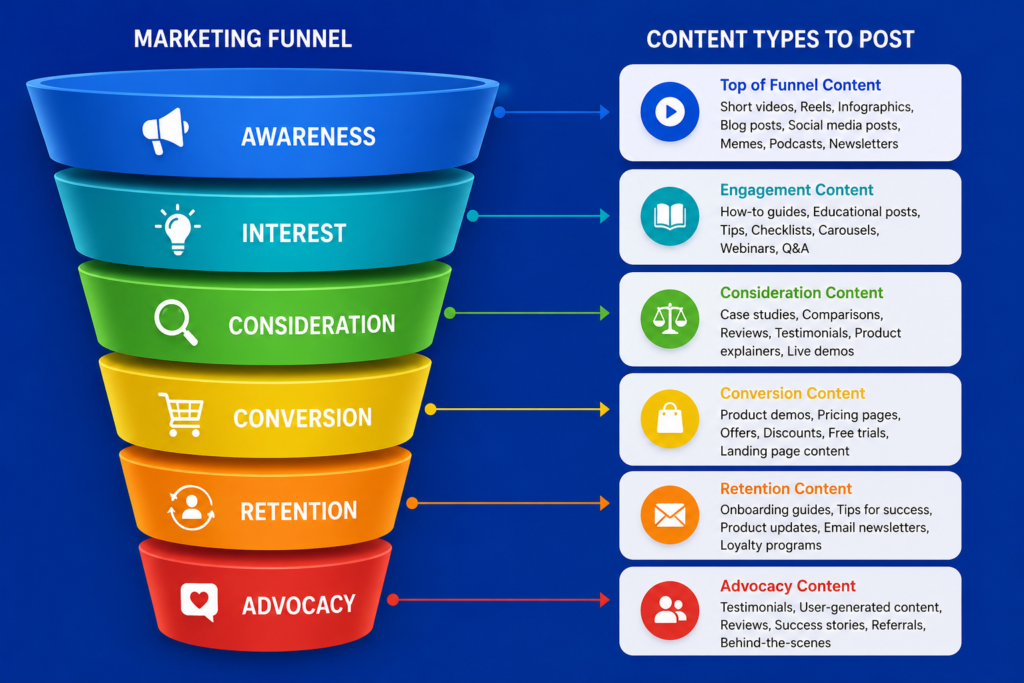
At the awareness stage, potential customers may not know that the brand exists. The goal is to introduce the business and attract attention. Social media content, SEO, YouTube videos, display advertising, influencer marketing, and educational content can all contribute to awareness.
During the interest stage, customers begin exploring a problem or opportunity. They may search Google, watch videos, read articles, follow brands on social media, or subscribe to newsletters. Businesses should provide useful information that helps potential customers understand their problem and possible solutions.
At the consideration stage, customers are actively evaluating different options. They may compare products, prices, features, reviews, testimonials, and competitors. Case studies, product demonstrations, comparison pages, reviews, and detailed landing pages can help customers move toward a purchase decision.
The conversion stage occurs when the customer takes the desired action. Depending on the business, this could be purchasing a product, booking an appointment, submitting a lead form, starting a free trial, downloading an application, or contacting the sales team.
Marketing does not end at conversion. Retention focuses on keeping customers engaged and encouraging repeat purchases. Email marketing, loyalty programs, customer support, personalized recommendations, and remarketing can help businesses maintain relationships with existing customers.
The final stage is advocacy. Satisfied customers may leave reviews, recommend the business, share content, create user-generated content, or refer other customers. This can create a cycle where existing customers contribute to future customer acquisition.
Audience Segmentation
Audience segmentation is the process of dividing a broad target market into smaller groups based on shared characteristics, needs, or behaviors. Segmentation allows marketers to create more relevant campaigns instead of using the same message for everyone.
Demographic segmentation can include factors such as age, income, occupation, education, and family status. Geographic segmentation focuses on location, such as country, state, city, or neighborhood. Psychographic segmentation considers interests, values, attitudes, lifestyles, and motivations. Behavioral segmentation focuses on actions such as previous purchases, website visits, content engagement, product usage, and interactions with advertisements.
| Segmentation | Examples |
|---|---|
| Demographic | Age, income, occupation |
| Geographic | Country, city, region |
| Psychographic | Interests, lifestyle, values |
| Behavioral | Purchases, engagement, browsing behavior |
Audience segmentation becomes especially important in digital marketing because platforms allow businesses to create highly specific audiences. A business can develop different messages for new visitors, existing customers, high-value customers, and people who have interacted with specific products or content.
Buyer Personas
A buyer persona is a detailed representation of an ideal customer based on research and customer data. Instead of thinking about the audience as a large anonymous group, marketers use personas to understand the people they are trying to reach.
A buyer persona can include the customer’s age range, location, occupation, goals, challenges, interests, purchasing motivations, objections, preferred marketing channels, and buying behavior.
For example, a digital marketing agency could have one persona representing a small business owner who wants more leads and another representing a marketing manager looking for an external agency to manage paid advertising. Both may need digital marketing services, but their problems, decision-making processes, and marketing messages can be very different.
Marketing Channels
Marketing channels are the platforms and methods businesses use to communicate with customers and generate demand. These channels can broadly be classified as owned, earned, and paid media.
Owned media includes assets controlled by the business, such as its website, blog, email database, application, and social media profiles. Earned media includes exposure generated through reviews, mentions, public relations, recommendations, and organic sharing. Paid media includes advertising channels such as Google Ads, Meta Ads, display advertising, sponsored content, and other paid placements.
| Channel | Typical Use |
|---|---|
| Website | Information, branding, conversion |
| SEO | Organic search visibility |
| Social Media | Awareness and engagement |
| Google Ads | Capturing search demand |
| Meta Ads | Audience targeting and demand generation |
| Email Marketing | Lead nurturing and retention |
| Content Marketing | Education and authority |
| Influencer Marketing | Reach and social proof |
| Affiliate Marketing | Performance-based acquisition |
A strong marketing strategy does not necessarily require every channel. Businesses should choose channels based on where their target audience spends time, what the business is trying to achieve, the available resources, and the economics of customer acquisition.
How to Use Social Media Marketing
Social media marketing involves using social platforms to build awareness, communicate with audiences, distribute content, generate leads, and support sales. Platforms such as Instagram, Facebook, LinkedIn, YouTube, TikTok, X, and Pinterest serve different audiences and content behaviors, so businesses should select platforms strategically.
A good social media strategy starts with a clear objective. A brand may want to increase awareness, build a community, generate leads, drive website traffic, or increase sales. Once the objective is defined, the business can create content pillars that support that objective.
For example, a digital marketing agency could use educational content to demonstrate expertise, case studies to provide proof, industry insights to build authority, behind-the-scenes content to humanize the company, and promotional content to generate leads.
Social media content can include short-form videos, images, carousels, stories, live videos, customer testimonials, product demonstrations, polls, and user-generated content. The most effective strategy usually combines valuable or entertaining content with promotional content rather than making every post a sales pitch.
Social media should also be connected to the wider marketing funnel. A social media post might generate awareness, a profile visit might create interest, a website article might support consideration, and a landing page or lead form might generate the conversion.
Search Engine Optimization
Search Engine Optimization, commonly known as SEO, is the process of improving a website’s visibility in organic search engine results. SEO helps businesses reach people who are actively searching for information, products, services, or solutions.
SEO generally consists of three major areas: on-page SEO, technical SEO, and off-page SEO. On-page SEO focuses on elements such as keywords, search intent, titles, headings, content, internal links, URLs, and images. Technical SEO focuses on crawlability, indexability, website speed, mobile usability, structured data, HTTPS, XML sitemaps, and other technical elements. Off-page SEO focuses on external signals such as backlinks, brand mentions, digital PR, and relevant online references.
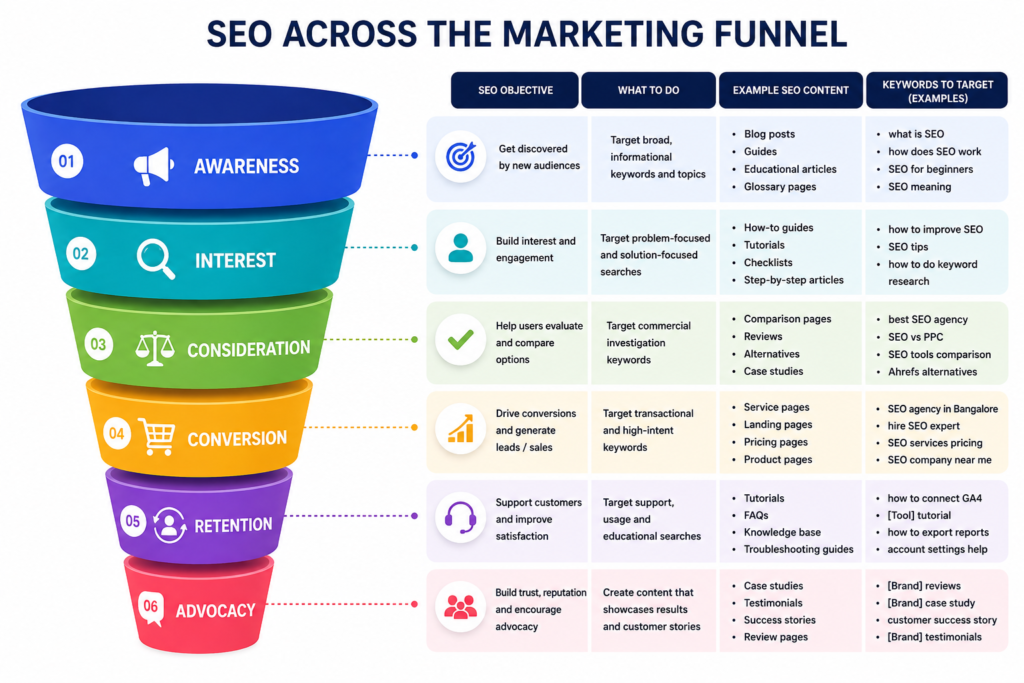
SEO is generally a long-term marketing channel. Unlike paid advertising, where traffic usually stops when the advertising budget stops, successful organic content can continue attracting visitors over an extended period. However, SEO requires ongoing investment in high-quality content, technical improvements, authority building, and performance analysis.
Google Ads
Google Ads is a paid advertising platform that allows businesses to reach users across Google’s advertising ecosystem. Search advertising is particularly useful because it can reach people who are actively searching for specific products or services.
For example, someone searching for “best digital marketing agency in Bangalore” may already have commercial intent. A relevant Google Search advertisement can place a business in front of that potential customer at an important point in the buying journey.
Google Ads can be used for different objectives and formats, including search advertising, shopping campaigns, display advertising, video advertising, and app promotion. The effectiveness of a campaign depends on the relationship between targeting, ad messaging, landing page quality, and conversion tracking.
A simplified Google Ads journey is:
Search Query → Advertisement → Landing Page → Conversion
Businesses should track conversions rather than focusing only on clicks or impressions. Important metrics can include click-through rate, cost per click, conversion rate, cost per acquisition, and return on ad spend.
Meta Ads
Meta Ads allow businesses to advertise across platforms such as Facebook and Instagram. Meta advertising is commonly used for brand awareness, demand generation, lead generation, e-commerce sales, remarketing, and audience development.
One important difference between Google Search Ads and Meta Ads is user intent. A person searching Google for a specific product or service may already be actively looking for a solution. A person scrolling through Instagram may not have been actively searching for the product. Meta advertising therefore often relies heavily on creative, audience signals, messaging, and the ability to generate interest.
Meta advertising typically uses a campaign, ad set, and ad structure. The campaign defines the overall objective, the ad set controls elements such as audience and budget structure, and the ad contains the creative and messaging presented to users.
Creative is particularly important in Meta advertising. Businesses can use static images, videos, Reels, carousels, testimonials, product demonstrations, and user-generated content. Strong creative often communicates a problem, solution, benefit, proof point, and call to action quickly.
SEO vs Google Ads vs Meta Ads
SEO, Google Ads, and Meta Ads can all generate traffic and customers, but they work differently.
| Factor | SEO | Google Ads | Meta Ads |
|---|---|---|---|
| Traffic | Organic | Paid search | Paid social |
| Intent | Often high | Usually high | Often discovery-based |
| Speed | Long-term | Fast | Fast |
| Cost Model | Investment in content/SEO | Pay for advertising | Pay for advertising |
| Main Strength | Sustainable organic visibility | Capture existing demand | Create and stimulate demand |
| Key Challenge | Time and competition | Rising CPCs and competition | Creative fatigue |
These channels should not necessarily be viewed as competitors. An effective digital marketing strategy may use SEO to capture organic search traffic, Google Ads to capture high-intent searches, and Meta Ads to create awareness and generate demand.
How Marketing Channels Work Together
Customers rarely follow a perfectly linear journey. A person may discover a brand through an Instagram Reel, search for the brand on Google, read a blog article, visit a product page, see a remarketing advertisement, and finally make a purchase.
This means businesses should think about marketing as an integrated system. For example, SEO can bring visitors to a website, social media can build familiarity, Google Ads can capture high-intent searches, Meta Ads can support remarketing, and email marketing can nurture leads.
A common integrated funnel might look like:
Social Media → Website → Lead Generation → Email Marketing → Remarketing → Conversion
Another could be:
SEO → Blog Article → Product Page → Remarketing → Purchase
The objective is to create a consistent customer journey where each channel supports the others.
Marketing Metrics and KPIs
Marketing performance should be measured using metrics that are connected to business objectives. Impressions and reach can help measure exposure, while clicks and click-through rate can help evaluate engagement. Conversion rate measures the percentage of users who complete a desired action.
For paid campaigns, metrics such as CPC, CPM, CPL, CPA, and ROAS are commonly used. At the business level, customer acquisition cost and customer lifetime value can provide a better understanding of whether marketing is economically sustainable.
| Metric | Meaning |
|---|---|
| CTR | Percentage of users who click |
| CPC | Cost per click |
| CPM | Cost per 1,000 impressions |
| Conversion Rate | Percentage of users who convert |
| CPL | Cost per lead |
| CPA | Cost per acquisition |
| ROAS | Revenue generated relative to ad spend |
| CAC | Customer acquisition cost |
| LTV | Customer lifetime value |
The most important principle is to avoid optimizing for vanity metrics alone. A campaign may generate thousands of clicks but produce very few customers. Business outcomes should ultimately determine whether marketing activity is successful.
Common Marketing Mistakes
One of the most common marketing mistakes is trying to target everyone. When a business attempts to communicate with everyone, its messaging often becomes generic and less persuasive. A clearly defined target audience allows the business to develop more relevant offers and communication.
Another common mistake is focusing entirely on individual channels. A business might spend heavily on social media but have no optimized website or conversion process. Similarly, a business may generate significant SEO traffic but fail to provide strong calls to action or landing pages.
Other common problems include running advertising without proper conversion tracking, creating content without understanding search intent, relying on followers instead of business outcomes, ignoring customer retention, changing campaigns too frequently, and failing to test different messages and creative concepts.
Marketing should be treated as a continuous process of testing, measuring, learning, and optimizing.
How to Create a Marketing Strategy
Creating a marketing strategy starts with research. A business needs to understand its market, competitors, customers, products, pricing, and competitive advantages. The next step is defining the target audience and identifying the problems, motivations, objections, and behaviors that influence purchasing decisions.
The business can then develop its value proposition and positioning. Once the positioning is clear, marketers can choose appropriate channels and create a funnel that moves customers from awareness to conversion and retention.
A practical marketing strategy can therefore follow this sequence:
Market Research → Audience → Positioning → Offer → Channels → Content → Funnel → Conversion → Retention → Measurement → Optimization
The strategy should also include measurable goals. Instead of simply setting a goal such as “increase social media followers,” a business could set goals around qualified leads, sales, customer acquisition cost, revenue, conversion rate, or return on advertising spend.
The Role of Content in Marketing
Content marketing supports almost every stage of the customer journey. Educational content can attract people who are researching a problem, comparison content can help prospects evaluate solutions, case studies can provide social proof, and product-focused content can help customers make purchasing decisions.
Content can take many forms, including blog articles, videos, podcasts, social media posts, case studies, guides, webinars, newsletters, and downloadable resources.
A strong content strategy should connect content topics with audience needs and marketing objectives. Instead of publishing content simply to maintain a posting schedule, businesses should ask what problem each piece of content solves and what action they want the reader or viewer to take next.
The Future of Marketing
Marketing is becoming increasingly data-driven, personalized, automated, and influenced by artificial intelligence. Businesses can use technology to analyze customer behavior, personalize communication, automate repetitive tasks, generate creative ideas, improve advertising campaigns, and understand large amounts of marketing data.
However, technology does not eliminate the fundamentals of marketing. A business still needs to understand its customers, develop a valuable product, communicate a compelling proposition, select the right channels, and deliver a strong customer experience.
The future of marketing will therefore combine human strategy and creativity with data, automation, and AI-powered tools.
Conclusion
Marketing is much broader than advertising. It is a complete business discipline that involves understanding customers, creating value, communicating that value, delivering products and services, generating demand, converting prospects, and building long-term relationships.
The **7Ps of marketing—Product, Price, Place, Promotion, People, Process, and Physical Evidence—**provide a useful framework for understanding the marketing mix. Audience segmentation helps businesses reach more relevant customers, while marketing funnels provide a framework for moving people from awareness to conversion and eventually advocacy.
Digital channels such as social media, SEO, Google Ads, and Meta Ads provide businesses with different ways to reach and influence customers. SEO helps capture organic search demand, Google Ads can capture high-intent searches, and Meta Ads can help businesses reach targeted audiences and generate demand.
The strongest marketing strategies do not depend on a single channel. They connect research, audience segmentation, positioning, content, advertising, SEO, social media, conversion optimization, analytics, and retention into one integrated system.
Ultimately, effective marketing can be summarized as:
Understand the audience → Create value → Communicate clearly → Reach the right people → Convert them → Retain them → Measure and optimize.
You Can Try reading this Book To Learn More about Marketing
Not A Marketing Book