
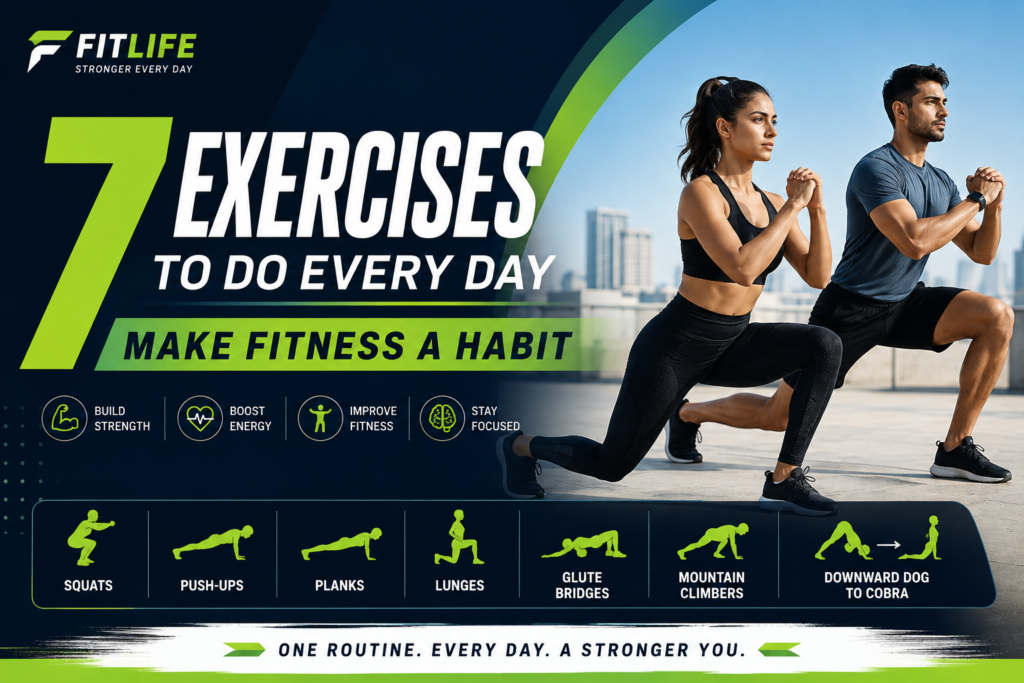
Building a consistent fitness routine does not always require spending hours at a gym. In fact, some of the most effective ways to stay active can be done at home with little or no equipment. The key is consistency. When movement becomes part of your everyday routine, exercise starts feeling less like a task and more like a normal part of your lifestyle.
The 7 exercises to do everyday in this guide are designed to cover several important areas of fitness, including strength, balance, mobility, flexibility, and cardiovascular conditioning. Squats, push-ups, planks, lunges, glute bridges, mountain climbers, and the downward dog to cobra movement can create a well-rounded routine when performed with proper technique and adjusted to your fitness level.
A daily exercise routine can also be flexible. Beginners may perform fewer repetitions or hold positions for shorter periods, while people with more experience can gradually increase repetitions, duration, or difficulty. The goal is not to exhaust yourself every day. The goal is to create a sustainable movement habit that supports your overall health.
Why You Should Make Exercise a Daily Habit
Regular physical activity can support stronger muscles, better mobility, improved cardiovascular fitness, and greater physical confidence. More importantly, creating a daily movement habit can make it easier to remain active over the long term. Waiting for motivation to appear before exercising often makes consistency difficult. A simple routine that is attached to an existing part of your day can be much easier to maintain.

Click On The text TO BUY Best Yoga mats
Daily exercise does not necessarily mean performing a hard workout every day. Your body needs recovery, particularly after demanding strength sessions. A daily fitness habit can include gentle mobility work, walking, stretching, or a shorter version of your regular workout on recovery days. This approach allows you to remain active without continuously placing high stress on the same muscles.
Another advantage of making exercise a habit is that it removes some of the decision-making involved in staying active. Instead of asking yourself whether you should work out, you can establish a predictable routine. For example, you might exercise after waking up, before taking a shower, during a lunch break, or in the evening. Over time, that activity can become a natural part of your schedule.
Exercise can also complement other healthy habits. Adequate sleep, nutritious food, hydration, stress management, and regular movement all contribute to a healthier lifestyle. You do not need to change everything at once. Starting with a manageable exercise routine can provide a foundation for making other positive changes.
The most important principle is sustainability. A routine that you can comfortably follow for months is generally more useful than an intense plan that you abandon after a week. Choose exercises that match your current ability and gradually progress as your strength and endurance improve.
7 Exercises to Do Every Day for Overall Fitness
The following 7 exercises to do everyday provide a simple combination of strength, core conditioning, balance, mobility, and cardiovascular movement. Although these exercises can be performed regularly, the intensity should depend on your fitness level and recovery needs.
You can begin with a short warm-up consisting of easy walking, arm circles, gentle hip movements, and controlled bodyweight movements. After warming up, perform the exercises using slow, controlled movements rather than rushing through repetitions. Proper form is more important than simply completing a high number of repetitions.
For a beginner, one possible starting point is 8 to 12 repetitions of strength exercises and 15 to 30 seconds for static exercises such as planks. You can complete one or two rounds initially. As your fitness improves, you can increase the number of repetitions or rounds gradually.
It is also important to recognize that not every day needs to look identical. If your muscles are tired after a demanding workout, reduce the intensity or focus on mobility and light activity. Exercise should challenge your body without consistently pushing it beyond its ability to recover.
Squats: One of the Best Lower Body Strength Exercises
Squats are one of the most accessible movements for developing lower-body strength. They involve several major muscle groups, including the quadriceps, glutes, and hamstrings. Because the movement resembles everyday actions such as sitting down and standing up, improving squat strength can also support functional movement.
To perform a bodyweight squat, stand with your feet approximately shoulder-width apart. Keep your chest comfortably lifted and your core engaged. Bend your knees and move your hips backward as though you are sitting toward a chair. Lower yourself as far as you can while maintaining comfortable control and good alignment. Then press through your feet to return to the standing position.
You do not need to squat extremely low to benefit from the movement. Your comfortable range of motion may depend on your mobility, strength, and experience. Focus on keeping the movement controlled and avoid allowing your knees to collapse inward.
Squats are particularly useful among lower body strength exercises because they can be modified in numerous ways. Beginners can practice sitting down onto a sturdy chair and standing back up. More experienced individuals can try pause squats, split squats, or eventually add external resistance.
A practical starting point is 8 to 15 repetitions. If you are using squats as part of a daily movement routine, concentrate on quality rather than attempting maximum repetitions every day.
Push-Ups: Effective Upper Body Strength Exercises
Push-ups are a classic bodyweight movement that can train the chest, shoulders, triceps, and core. They are also easy to modify, making them suitable for different fitness levels.
Start in a plank position with your hands positioned slightly wider than your shoulders. Keep your body relatively straight from your head through your hips and toward your feet. Bend your elbows and lower your chest toward the floor while maintaining control. Then push through your hands to return to the starting position.
If a standard push-up is too challenging, you can begin with wall push-ups. Standing several steps away from a wall, place your hands against it and slowly bend and straighten your elbows. Another option is an incline push-up using a stable elevated surface.
As your upper-body strength improves, you can gradually progress toward floor push-ups. Maintaining a strong body position is important because allowing your hips to sag or rushing through repetitions can reduce the quality of the movement.
Push-ups are excellent upper body strength exercises, but they also require core stability. This makes them a useful addition to a short full-body workout. Start with a number of repetitions that you can perform with good technique and stop before your form breaks down.
Planks: Strengthen Your Core and Improve Stability
The plank is a simple exercise that challenges your core while requiring the rest of your body to remain stable. A strong core can help support posture and controlled movement during other exercises and everyday activities.
To perform a basic forearm plank, place your forearms on the floor and extend your legs behind you. Keep your elbows approximately underneath your shoulders. Engage your abdominal muscles and maintain a controlled body position. Avoid lifting your hips excessively or allowing your lower back to collapse.
Beginners can perform the plank from their knees or hold the standard position for a shorter period. Instead of trying to hold a plank for several minutes, focus on maintaining good alignment for 15 to 30 seconds. Gradually increase the duration as your ability improves.
The plank is not just an abdominal exercise. Your shoulders, hips, legs, and other stabilizing muscles contribute to maintaining the position. This makes it a useful movement for developing whole-body control.
For variety, you can eventually introduce side planks or other core variations. However, a basic plank is sufficient for beginners who are building a consistent routine.
Lunges: Build Stronger Legs and Better Balance
Lunges are another effective lower-body movement that can train the quadriceps, glutes, and hamstrings while also challenging balance and coordination. Unlike a standard squat, lunges place the legs in different positions, requiring each side of the body to work independently.
Begin by standing upright with your feet comfortably apart. Step forward with one leg and lower your body by bending both knees. Keep the front knee controlled and avoid allowing it to collapse inward. Push through the front foot to return to your starting position, then repeat on the other side.
If forward lunges feel uncomfortable, you can practice reverse lunges. Instead of stepping forward, take one foot backward and lower your body. Reverse lunges may feel more controlled for some beginners because they can make it easier to maintain balance.
You can start with 6 to 10 repetitions per leg and increase gradually. Holding onto a stable surface can provide additional support while you learn the movement.
Lunges are valuable because they combine strength and balance. They can also help you identify differences in strength or control between your left and right sides. Performing the movement slowly can make it easier to maintain good technique.
Glute Bridges: Strengthen Your Glutes and Lower Body
Glute bridges are performed on the floor and primarily target the glute muscles while also involving the hamstrings and core. They are particularly useful for people who spend long periods sitting because they provide an opportunity to actively move the hips through a controlled range of motion.
Lie on your back with your knees bent and your feet flat on the floor. Keep your arms comfortably beside your body. Engage your core, press through your feet, and lift your hips toward the ceiling. Pause briefly at the top while squeezing your glutes, then lower your hips slowly.
Avoid turning the movement into an exaggerated backbend. The goal is to extend the hips while keeping the movement controlled. You should feel the glutes doing most of the work rather than relying on your lower back.
Beginners can start with 10 to 15 repetitions. As the movement becomes easier, you can introduce variations such as single-leg bridges or longer pauses at the top.
Glute bridges work well alongside squats and lunges because they provide another way to strengthen the lower body. Including different movement patterns can create a more balanced routine.
Mountain Climbers: Combine Cardio With Core Training
Mountain climbers add a more dynamic element to the routine. They can increase your heart rate while requiring your core and upper body to stabilize the body.
Start in a high plank position with your hands underneath or slightly wider than your shoulders. Bring one knee toward your chest and then return it to the starting position as you bring the opposite knee forward. Continue alternating legs in a controlled rhythm.
Beginners do not need to perform mountain climbers at high speed. Moving slowly can help you learn the coordination required for the exercise and maintain better control. As your conditioning improves, you can increase the pace.
Mountain climbers can be demanding, so they may not need to be performed at maximum intensity every day. You can incorporate them into a short circuit or use them on days when you want additional cardiovascular movement.
If maintaining the plank position is difficult, you can place your hands on a stable elevated surface and perform the movement from there. This modification reduces some of the difficulty while allowing you to practice the movement pattern.
Downward Dog to Cobra: Improve Flexibility and Mobility
The downward dog to cobra sequence adds flexibility and mobility work to a routine that otherwise contains several strength-focused movements. It can encourage controlled movement through the shoulders, spine, hips, and legs.
Begin from a hands-and-knees position. Push your hips upward and backward into a downward dog position while keeping your movements comfortable. From there, transition forward and lower your hips toward the floor into a gentle cobra position. Move between the two positions slowly rather than forcing your body into a deep stretch.
Flexibility varies significantly from person to person. You should not force a position simply because someone else can move farther. A comfortable stretch is generally more appropriate than an aggressive one.
This movement can also provide a useful transition between strength exercises and the end of a workout. Spending a few controlled repetitions moving between the positions can help you focus on mobility and body awareness.
When combined with squats, push-ups, lunges, glute bridges, planks, and mountain climbers, this movement helps create a routine that addresses more than just muscle strength.
7 Exercises to Do Everyday for Girls
The same fundamental exercises can be highly effective for girls and women. Fitness exercises do not need to be completely different based on gender. What matters more is age, current fitness level, physical ability, goals, experience, and recovery.
The 7 exercises to do everyday for girls can include squats, modified or standard push-ups, planks, lunges, glute bridges, mountain climbers, and downward dog to cobra. These movements can be adjusted to suit beginners and progressively made more challenging as strength improves.
For someone just starting, bodyweight exercises are often a practical option because they do not require a gym membership or expensive equipment. A beginner might perform 8 to 10 squats, 5 to 8 incline push-ups, a 15-second plank, 6 lunges per side, 10 glute bridges, 20 seconds of controlled mountain climbers, and several downward dog-to-cobra repetitions.
Girls and teenagers who are still growing should prioritize learning proper movement patterns rather than focusing on maximum intensity or appearance. Exercise should support strength, confidence, coordination, mobility, and overall well-being rather than becoming a punishment for eating or a way to chase unrealistic body standards.
Women who already exercise regularly can modify the routine by adding resistance, increasing repetitions, or using more advanced variations. However, rest remains important. A daily habit does not mean every session needs to be intense.
It is also useful to choose activities that are enjoyable. Dancing, cycling, swimming, walking, sports, yoga, and other recreational activities can complement a basic exercise routine and make staying active more enjoyable.
7 Exercises to Do Everyday for Boys
Boys can also use these seven movements as a foundation for developing strength, mobility, coordination, and general fitness. The 7 exercises to do everyday for boys are not fundamentally different from those recommended for girls. The appropriate level of difficulty should depend on the individual’s age, experience, ability, and goals.
Younger boys should focus on movement quality, coordination, and enjoying physical activity rather than trying to lift heavy weights or complete extremely demanding workouts. Bodyweight exercises can be introduced through age-appropriate activities and supervised when necessary.
Older teenagers and adults can gradually increase the challenge through additional repetitions, resistance training, sports, or more advanced variations. For example, regular squats can eventually progress toward loaded squats, while push-ups can progress to more challenging variations.
Fitness should not be treated as a competition with friends or social media personalities. Everyone develops at a different pace. Comparing yourself with someone who has a different training history can create unrealistic expectations.
A balanced approach includes exercise, nutritious food, adequate sleep, hydration, and recovery. The purpose of a fitness routine is to build physical capability and support a healthy lifestyle rather than simply chase a particular appearance.
What to Eat Before and After Your Daily Workout
Food provides the energy required for physical activity and the nutrients needed for recovery. What you eat before exercise can depend on the timing of your workout, its intensity, and your individual preferences.
If you exercise shortly after waking up and the workout is light, you may not need a large meal beforehand. Some people prefer exercising after a small snack, while others are comfortable working out before breakfast. If you have several hours before your workout, a balanced meal containing carbohydrates, protein, and some healthy fats can provide useful energy.
Simple pre-workout options may include a banana with yogurt, oats with fruit, whole-grain toast with a protein-rich food, or another familiar meal that you tolerate well. Avoid experimenting with unfamiliar foods immediately before demanding exercise.
After exercise, a balanced meal can help replenish energy and provide protein for muscle repair. Options can include eggs with whole grains and vegetables, yogurt with fruit and oats, dal with rice and vegetables, paneer with roti and vegetables, or another balanced meal that fits your dietary preferences.
Hydration is equally important. Drink water throughout the day and pay attention to your fluid needs, especially in hot weather or during longer workouts.
There is no single perfect meal that everyone must eat before or after exercise. Your overall diet matters more than one particular meal.
Nutrition Essentials for Building Strength and Staying Fit
Exercise is only one part of maintaining fitness. Nutrition provides the building blocks and energy your body needs to function, recover, and adapt to training.
Protein is particularly important for muscle maintenance and repair. Foods such as eggs, dairy products, beans, lentils, soy foods, fish, poultry, and other protein-rich foods can contribute to a balanced diet. You do not necessarily need expensive products or specialized foods to obtain protein.
Carbohydrates are another important source of energy, particularly for people who exercise regularly. Rice, potatoes, oats, whole grains, fruits, and other carbohydrate-containing foods can be included according to individual needs.
Healthy fats also have a role in a balanced diet. Nuts, seeds, avocados, and certain plant oils can provide fats along with other nutrients.
Fruits and vegetables add vitamins, minerals, fiber, and other beneficial compounds. Instead of focusing on one “superfood,” aim for variety across your meals.
Portion requirements differ between individuals. Factors such as age, body size, activity level, goals, and overall diet influence nutritional needs. Someone training intensely will generally have different energy requirements from someone performing a short daily routine.
Rather than eliminating entire food groups unnecessarily, focus on creating balanced meals and developing eating habits that you can maintain. Extreme diets may be difficult to sustain and can make it harder to support regular physical activity.
Do You Need Supplements for Daily Exercise?
Most people beginning a simple exercise routine do not automatically need supplements. A balanced diet can provide many of the nutrients required for everyday activity.
Supplements can have specific uses in certain circumstances, but they should not be considered a replacement for nutritious food, adequate sleep, or consistent exercise. Protein powders, for example, can be convenient when someone has difficulty obtaining enough protein from regular meals, but they are not essential for everyone.
The same principle applies to vitamins and minerals. Taking large amounts of supplements without a genuine need is not automatically better. Some nutrients can be harmful in excessive amounts.
If you suspect that your diet is lacking a particular nutrient or you have a specific health or dietary concern, it is sensible to discuss it with a qualified healthcare professional or registered dietitian before starting supplements.
For most beginners, the priorities should be simple: establish a sustainable exercise routine, eat a balanced diet, drink enough fluids, sleep well, and allow the body to recover.
Tips to Make Exercise, Diet, and Recovery Part of Your Daily Routine
The easiest way to make exercise a habit is to remove unnecessary barriers. Keep your workout simple enough that you can realistically perform it on busy days. You do not need a perfect home gym or a complicated training program to stay active.
Choose a consistent time. Some people find mornings convenient, while others prefer exercising after work or school. The best time is the one that fits your lifestyle and is easiest for you to maintain.
Start small. If completing all seven exercises feels overwhelming, begin with one round. Once the routine becomes familiar, you can gradually increase the volume. A short workout performed consistently is often more sustainable than an ambitious routine that you rarely complete.
Track your progress without becoming obsessed with numbers. You might record how many repetitions you perform, how long you hold a plank, or simply mark the days when you were active. Seeing a consistent pattern can reinforce the habit.
Make your environment supportive. Keep comfortable workout clothes accessible, clear a small area for exercise, and prepare anything you need in advance. Reducing small obstacles can make it easier to get started.
Listen to your body. Normal muscle fatigue is different from sharp or unusual pain. If an exercise causes pain, stop and reassess your technique. Persistent or concerning symptoms should be evaluated by an appropriate healthcare professional.
Recovery deserves the same attention as exercise. Sleep is particularly important because your body uses rest periods to recover from physical stress. If you continuously feel exhausted, your routine may need to be adjusted.
Your diet should also support your activity rather than work against it. Instead of chasing complicated meal plans, focus on regular balanced meals, adequate protein, fruits and vegetables, appropriate carbohydrate sources, healthy fats, and sufficient hydration.
Finally, remember that consistency does not mean perfection. Missing a workout does not erase your progress. If you skip one day, simply return to your routine the next time you can. The goal is to build a lifestyle in which movement becomes normal.
The 7 exercises to do everyday can provide a useful starting point for people who want a straightforward full-body routine. Squats and lunges help develop lower-body strength, push-ups train the upper body, planks challenge the core, glute bridges strengthen the hips and glutes, mountain climbers add a cardiovascular component, and downward dog to cobra introduces mobility and flexibility.
However, these exercises should be viewed as a foundation rather than a complete fitness prescription for every person. Your routine should change as your goals, fitness level, schedule, and recovery needs change. Some days may be focused on strength, while others can emphasize walking, stretching, mobility, or recreational activities.
The biggest benefit comes from turning exercise into something you can maintain. You do not need to chase exhausting workouts or complicated programs to become more active. Start with manageable movements, practice good technique, fuel your body appropriately, recover well, and gradually challenge yourself.
When exercise becomes a regular part of your day, small efforts can add up over time. The objective is not to become perfect overnight. It is to create habits that support a stronger, healthier, and more active lifestyle for the long term.