
Digital advertising has changed dramatically over the last few years. Advertisers no longer have to manually contact publishers, negotiate rates, pick individual websites, and manage every placement by hand. Today, most of the buying and selling of ad space is automated through programmatic advertising — and understanding SSP, DSP and Ad Exchange technology is the fastest way to understand how that automation actually works.
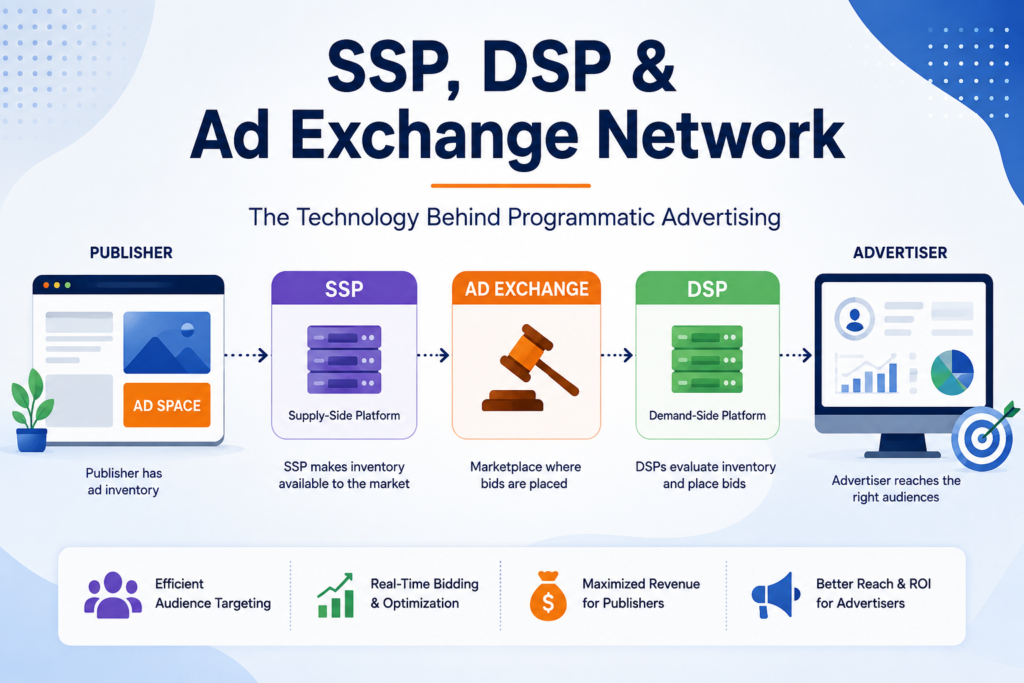
At the center of this ecosystem are three components: Supply-Side Platforms (SSPs), Demand-Side Platforms (DSPs), and Ad Exchanges. Although the names sound technical, their roles are simple: an SSP helps publishers sell ad space, a DSP helps advertisers buy it, and an ad exchange is the automated marketplace that connects the two.
This guide breaks down what each platform does, how they work together in real time, and why they matter — whether you’re a publisher trying to monetize traffic, an advertiser running programmatic campaigns, or just someone curious how a website decides which ad to show you.
Key Takeaways
- SSP (Supply-Side Platform) — technology that helps publishers sell ad inventory.
- DSP (Demand-Side Platform) — technology that helps advertisers buy ad inventory.
- Ad Exchange — the marketplace where SSPs and DSPs meet and transact, usually via Real-Time Bidding (RTB).
- The entire process — from a page loading to an ad being selected and displayed — typically happens in under a second.
What Is an SSP?
SSP stands for Supply-Side Platform. It’s a technology platform that helps publishers sell their available digital advertising inventory to advertisers automatically.
A publisher could be a website, mobile app, video platform, news portal, or any digital property with space available for ads. For example, imagine a news website that gets a million visitors a month, with ad slots on its homepage, article pages, videos, and mobile app. Instead of manually selling each of those slots to different companies, the publisher plugs into an SSP and lets it automate the process — connecting that inventory to multiple sources of demand at once and helping manage and optimize the resulting ad revenue.
How Does an SSP Work?
When a visitor opens a webpage containing an ad slot, the publisher’s system detects that an ad impression is available. The SSP then makes information about that opportunity available to connected demand sources, so advertisers can evaluate it and decide whether to bid. Along the way, the SSP also helps the publisher manage different demand sources, apply pricing rules, and decide which demand is even eligible for that inventory.
In simple terms:
Publisher → SSP → Advertising Marketplace → Advertiser
Examples of SSPs
Some well-known SSP and publisher-monetization platforms include:
- Google Ad Manager
- Magnite
- PubMatic
- OpenX
- Index Exchange
Each platform offers a different mix of features, integrations, ad formats, and approach to publisher monetization, so most large publishers connect to more than one at the same time (a setup often called “header bidding”).
What Is a DSP?
DSP stands for Demand-Side Platform. It’s a technology platform that helps advertisers and agencies buy digital advertising inventory programmatically, across thousands or even millions of websites and apps, without having to negotiate with each publisher one by one.
Through a DSP, advertisers set campaign requirements such as:
- Target audience
- Location
- Budget
- Device
- Advertising format
- Campaign objective
- Frequency
- Bid strategy
The DSP then evaluates every available ad opportunity against those requirements in real time and decides whether it’s worth bidding on.
How Does a DSP Work?
Suppose a company is promoting a new digital marketing course and wants to reach people interested in digital marketing and related topics. Instead of approaching hundreds of websites individually, the advertiser uses a DSP to access programmatic inventory across connected marketplaces. When a matching opportunity appears, the DSP evaluates it against the campaign’s settings — and if it qualifies, submits a bid. If that bid wins the auction, the ad is shown to the user, all within a fraction of a second.
Examples of DSPs
Popular DSP examples include:
- Google Display & Video 360
- The Trade Desk
- Amazon DSP
- Yahoo DSP
- StackAdapt
These platforms give advertisers and agencies tools for campaign management, audience targeting, bidding, optimization, and measurement — all from one dashboard.
What Is an Ad Exchange?
An Ad Exchange is a digital marketplace where advertising inventory is bought and sold programmatically — the easiest way to picture it is as the meeting point that connects advertising supply and demand.
On one side, publishers have ad inventory they want to sell. On the other, advertisers want to buy ad opportunities that match their campaigns. An SSP makes a publisher’s inventory available to the exchange, while DSPs represent advertisers looking to buy suitable impressions, and the exchange facilitates the auction and transaction between them according to its rules.
A Simple Example
Imagine you visit a technology website and there’s an empty ad space at the top of an article. The site needs to decide which ad appears there. That opportunity is offered through the publisher’s SSP into the connected marketplace, where multiple advertisers whose DSPs think their audience matches may submit bids. The auction determines the winning eligible bid, and the selected ad is delivered — all of this happening extremely quickly, before the page has even finished loading.
SSP vs DSP vs Ad Exchange
The easiest way to understand the difference is to look at who each platform actually serves.
| Platform | Primary User | Main Purpose |
|---|---|---|
| SSP | Publishers | Sell advertising inventory |
| DSP | Advertisers and agencies | Buy advertising inventory |
| Ad Exchange | Buyers and sellers | Facilitate programmatic transactions |
Think of it like a traditional marketplace: the publisher is the seller, the advertiser is the buyer, the SSP helps the seller manage inventory, the DSP helps the buyer purchase inventory, and the ad exchange is the marketplace where the transaction happens. The diagram below shows how those roles connect.
The Programmatic Ecosystem at a Glance
Has ad space to sell
Manages & sells inventory
Wants to reach users
Buys inventory on their behalf
How SSP, DSP and Ad Exchange Work Together
The three components are closely connected within programmatic advertising. Here’s the simplified, step-by-step version of what happens between a page loading and an ad appearing on it:
From Page Load to Ad Impression
This entire sequence — steps 1 through 9 — typically completes in well under a second, which is why it’s often called real-time bidding.
What Is Real-Time Bidding?
One of the key technologies behind programmatic advertising is Real-Time Bidding (RTB), which lets advertisers compete for individual ad impressions through automated auctions, defined as an open standard by the IAB Tech Lab’s OpenRTB protocol.
For example, suppose a user visits a website about business and entrepreneurship, and an ad slot becomes available. Several advertisers may be interested in reaching that user: Advertiser A might bid ₹20 for the impression, Advertiser B might bid ₹25, while Advertiser C decides the impression doesn’t match its campaign and skips it entirely. The auction then determines the winning eligible bid based on the exchange’s rules, and the selected ad is displayed to the user.
It’s worth noting that RTB is only one part of the wider programmatic ecosystem — programmatic advertising can also involve other buying methods, such as private marketplaces (PMPs) and programmatic guaranteed deals.
A Real-World Example of SSP and DSP
Consider an online fashion publisher that writes an article titled “Top Fashion Trends for 2026,” which thousands of people visit every day. Rather than manually selling the ad spaces around that article, the publisher connects them to an SSP.
Now imagine a clothing brand wants to advertise its latest collection. The brand uses a DSP to find suitable ad opportunities. When a relevant impression becomes available on that fashion article, the DSP evaluates it against the campaign’s requirements and, if it’s a good match, joins the auction through the applicable marketplace. If the brand wins, its ad is shown to the visitor.
From the visitor’s side, it looks simple: they open an article and see a fashion ad. Behind the scenes, several automated technologies just worked together to decide exactly which ad that would be.
Why Are SSPs Important for Publishers?
1. Automated Inventory Selling
Publishers can automate the process of making ad inventory available to potential buyers, instead of selling every placement by hand.
2. Access to Multiple Demand Sources
An SSP connects publishers with different sources of programmatic demand at once, rather than relying on a single buyer.
3. Revenue Optimization
Publishers can use SSP features and marketplace competition to help optimize the value of their advertising inventory.
4. Better Inventory Management
Publishers can manage ad placements, formats, pricing rules, and other settings through one technology platform instead of many.
Why Are DSPs Important for Advertisers?
1. Efficient Media Buying
Advertisers can access ad opportunities across multiple digital environments from a single, centralized platform.
2. Audience Targeting
DSPs offer targeting and audience capabilities that vary by platform, available inventory, and applicable privacy rules.
3. Automated Bidding
Instead of negotiating every impression manually, advertisers can use automated bidding strategies that adjust in real time.
4. Campaign Optimization
Advertisers can analyze campaign performance and adjust targeting, budget, or creative based on their objectives and available data — a discipline that overlaps closely with broader digital marketing strategy.
Benefits and Challenges of Ad Exchange Networks
Ad exchanges make digital advertising transactions more scalable and efficient. For publishers, they open access to additional sources of demand; for advertisers, they open access to a much wider range of inventory; and for the ecosystem as a whole, automated marketplaces help match available impressions with advertiser demand far more efficiently than manual deals ever could.
That said, the ecosystem also comes with real challenges — ad fraud, brand safety, privacy, transparency, identity management, and measurement chief among them. Advertisers and publishers need appropriate controls and trusted technology partners, which is why industry initiatives like the Interactive Advertising Bureau’s (IAB) brand safety and ads.txt standards exist — to give both sides a shared framework for managing these risks responsibly.
SSP, DSP and Ad Exchange: An Easy Way to Remember
If you’re new to programmatic advertising, remember these three simple definitions:
SSP = Helps publishers sell
DSP = Helps advertisers buy
Ad Exchange = Connects supply and demand
Think of it like an online marketplace: a publisher has ad space to sell, the SSP helps make that space available, advertisers want to buy ad opportunities, the DSP helps them find and bid on suitable inventory, and the ad exchange is the marketplace where supply and demand actually meet.
The Future of Programmatic Advertising
Programmatic advertising keeps evolving as the digital advertising industry changes. Privacy regulations, browser changes, the decline of third-party cookies in some environments, connected TV, mobile advertising, retail media, artificial intelligence, and improved measurement technologies are all reshaping the ecosystem.
Advertisers are increasingly focused not just on reaching large audiences, but on reaching relevant ones while respecting user privacy and improving measurement — a shift that also mirrors best practices in SEO and organic content strategy, where relevance increasingly beats raw reach. Publishers, meanwhile, are looking for ways to grow monetization while keeping the user experience intact. As these changes continue, SSPs, DSPs, ad exchanges, and the wider ad-tech industry will keep playing a central role in how digital advertising works.
Frequently Asked Questions
Is Google Ad Manager an SSP or a DSP?
Google Ad Manager is primarily an SSP (and ad server) used by publishers to sell inventory. Google’s DSP equivalent for advertisers is Google Display & Video 360.
Can a publisher use more than one SSP at the same time?
Yes. Most large publishers connect to several SSPs simultaneously — a common setup known as header bidding — so more demand sources compete for the same inventory, which typically increases revenue.
Do advertisers need a DSP if they’re only running a small campaign?
It depends on scale. Small, single-site campaigns can often be bought directly from a publisher, but any advertiser wanting to reach audiences across many sites or apps efficiently will generally need a DSP.
Is Real-Time Bidding the same thing as programmatic advertising?
No. RTB is one buying method within programmatic advertising. Programmatic also includes private marketplaces (PMPs) and programmatic guaranteed deals that don’t rely on an open real-time auction.
Conclusion
SSPs, DSPs, and ad exchanges are the fundamental building blocks of modern programmatic advertising. An SSP (Supply-Side Platform) helps publishers manage and sell their available inventory. A DSP (Demand-Side Platform) helps advertisers and agencies buy inventory based on their campaign requirements. An ad exchange is the marketplace that connects that supply with that demand.
When these technologies work together, advertisers get access to digital ad opportunities at scale, while publishers get access to a much broader pool of potential buyers. The next time an ad appears while you’re reading an article, watching a video, or using an app, remember: the process behind that single impression involved multiple technologies working together in a fraction of a second. Understanding SSPs, DSPs, and ad exchanges is an important first step toward a solid foundation in programmatic advertising and modern digital marketing.